
Slots ·
Two numbers tell you more about a slot than its theme, soundtrack or graphics: RTP and volatility. Understanding them won’t guarantee a win, because no strategy can, but it will help you pick games that suit your budget, your patience and how you like to play.
This guide explains slot RTP for Malaysian players in plain English, shows how slot volatility changes the feel of a game, and gives a practical checklist for how to choose slot games at M2 Casino.
What Is RTP?
RTP stands for Return to Player. It’s the percentage of all money wagered on a slot that the game is designed to pay back to players over a very large number of spins.
Here’s an illustrative example only: a slot with an RTP of 96% is designed to return, on average, RM96 for every RM100 wagered, measured across millions of spins by all players. The remaining share is the house edge.
The key phrase is “over a very large number of spins”. RTP is a long-run average, not a promise about your session. In ten minutes of play you could finish well above or well below that figure. That’s normal, and it’s why RTP should be one factor in your choice rather than the only one.
RTP versus house edge
RTP and house edge are two sides of the same number. If the illustrative slot above has a 96% RTP, its house edge is 4%. A lower house edge means that, over the long run, a smaller share of each bet is kept by the game.
Where to find a slot’s RTP
Most game studios publish RTP inside the game itself:
- Open the slot from the popular games lobby.
- Tap the i, ? or menu icon, usually in a corner of the screen.
- Look in the game rules or paytable section. RTP is often near the bottom.
Studios such as Pragmatic Play, JILI, Playtech, JDB, Fa Chai and Lucky365 typically include this in their game rules. Some games list more than one RTP figure, for example a separate number for a bonus-buy feature, so read the rules carefully.
What Is Slot Volatility?
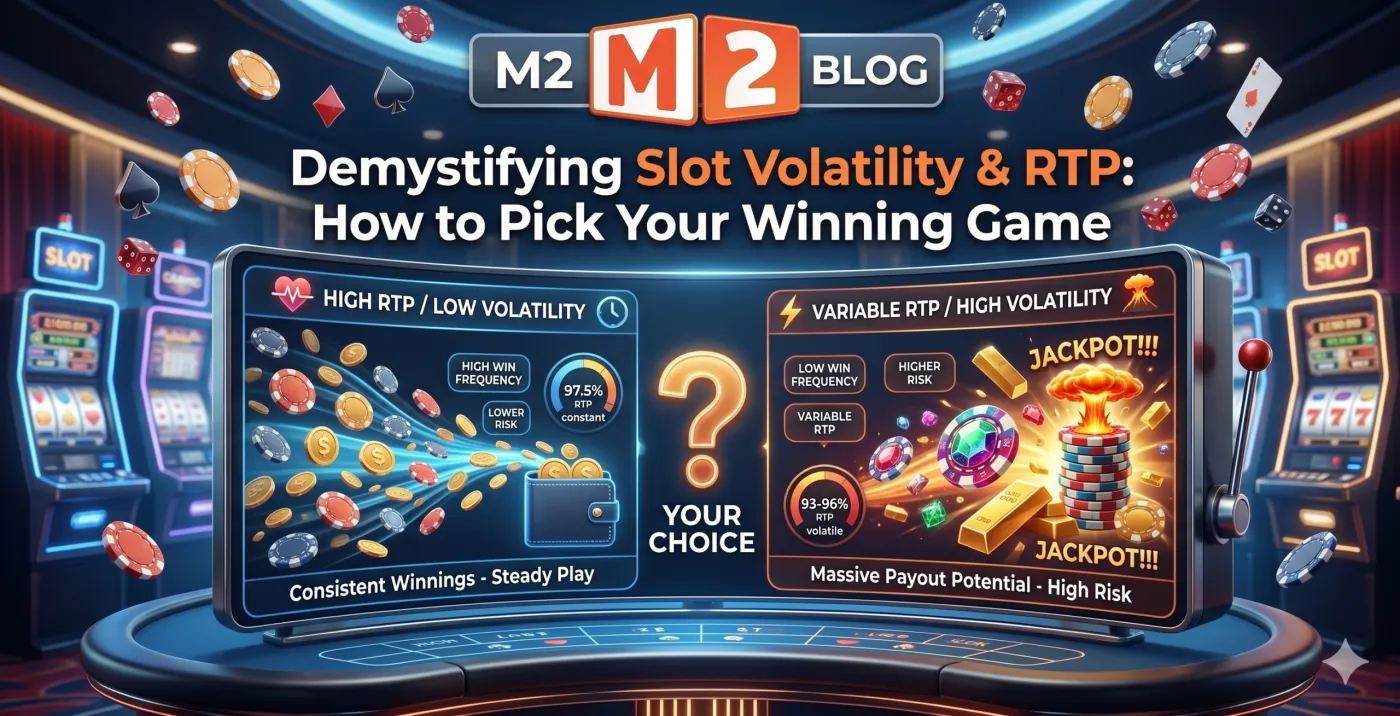
Volatility (sometimes called variance) describes how a slot pays out its RTP: how often wins land, and how big they tend to be.
| Volatility | How wins land | Typical feel | Suits |
|---|---|---|---|
| Low | Frequent, mostly small | Steady balance, fewer big moments | Longer sessions, smaller budgets |
| Medium | A mix of small and larger wins | Balanced swings | Most players |
| High | Rare, but can be large | Long quiet spells, big bonus potential | Patient players with a budget set aside |
Two slots with the same RTP can feel completely different because of volatility. A low-volatility game spreads its returns across many small wins. A high-volatility game saves more of its returns for rare, larger payouts, often inside free-spin or bonus rounds.
How to spot volatility
Not every game states its volatility, but you can often find clues:
- In the game info: some studios show a volatility rating, such as a row of lightning bolts or a label like “high”.
- In the paytable: a huge gap between the smallest and largest payouts usually points to higher volatility.
- In the features: games built around multipliers, cascading reels or big bonus rounds tend to be more volatile.
- In play: if you spin twenty or thirty times at the minimum bet and see very few wins, the game is probably on the higher side.
RTP and Volatility Together
It helps to think of RTP as how much a game returns over time, and volatility as the pattern in which it returns it.
| Combination | What to expect |
|---|---|
| Higher RTP, low volatility | Gentle swings, balance tends to move slowly |
| Higher RTP, high volatility | Decent long-run return, but short sessions can swing hard |
| Lower RTP, low volatility | Frequent small wins, but the balance drifts down over time |
| Lower RTP, high volatility | The most unpredictable combination, so keep bets small |
Neither number tells you what will happen on the next spin. Each result is decided by a random number generator, and past spins have no effect on future ones.
Slot Features and How They Affect Volatility
Modern slots are packed with features, and many of them shape how volatile a game feels. Knowing what each one does makes the game rules much easier to read.
- Free spins: a bonus round, usually triggered by scatter symbols, where you spin without paying. In many high-volatility games, a large share of the return is concentrated here.
- Multipliers: these multiply a win by a set amount. Games that rely on big multipliers tend to have more extreme swings.
- Cascading or tumbling reels: winning symbols disappear and new ones drop in, allowing several wins from one spin.
- Wilds and expanding symbols: these substitute for other symbols or grow to cover a reel, making wins more likely on that spin.
- Bonus buy: some games let you pay a set price to go straight to the bonus round. It costs a lot more than a normal spin and can swing sharply, so treat it with care and check whether it has its own RTP figure in the rules.
- Fixed jackpots: a top prize written into the paytable. Big jackpots usually mean the smaller wins are less generous.
None of these features change the basic rule: the game is built to return its RTP over a very long run, and short sessions can go either way.
A Worked Example: Planning a Session
Here’s an illustrative example, not a recommendation. Say you’ve set aside RM100 for an evening’s entertainment and you’d like around 200 spins.
- RM100 divided by 200 spins works out at RM0.50 per spin.
- With that bet size, a low-to-medium volatility game gives you a good chance of reaching your spin target, with regular small wins topping up your balance along the way.
- A high-volatility game at the same bet could run your balance down much faster during a quiet spell, or land a big bonus round early. Both are normal.
- If you’d rather try a high-volatility game, you could lower your bet so the same budget covers more spins.
Whatever happens, the plan ends when the RM100 is gone or when your time is up. Winnings are a nice surprise, not a reason to keep going or to raise your bets.
How to Choose Slot Games That Fit Your Budget
Here’s a simple process for picking a game.
1. Set your budget first
Decide how much you’re comfortable spending before you open any game. Treat it as the cost of entertainment, the same way you’d budget for a film or a meal out. Money for bills, savings or debt repayments should never be part of it.
2. Decide on session length
A useful rule of thumb is to divide your budget by the number of spins you’d like to enjoy. That gives you a sensible bet size. If the result is below a game’s minimum bet, choose a lower-volatility game or plan a shorter session.
3. Match volatility to your goal
- Smaller budget or longer sessions: low-to-medium volatility helps your balance last.
- Chasing features and bonus rounds: high-volatility games can pay more in bonus rounds, but expect dry spells and keep bets small.
- Just exploring: medium volatility gives you a feel for a game without extreme swings.
4. Check the RTP in the game rules
Where two games appeal to you equally, the one with the higher published RTP returns more over the long run. It won’t change your next spin, but it’s a sensible tie-breaker.
5. Test at the minimum bet
When you try a new game, start at the minimum bet for twenty or thirty spins. Watch how often it pays, how the features trigger, and whether you actually enjoy it.
6. Read the promotion terms
If you’re playing with a bonus from the promotion page, check the terms. Some offers have turnover requirements or exclude certain games, and unfinished turnover is a common reason withdrawals are held.
Common Slot Myths
- “A slot is due to pay.” Each spin is independent. A long losing run doesn’t make a win more likely.
- “Higher bets raise the RTP.” In the vast majority of slots, RTP is the same at every bet size. Check the game rules if you’re unsure.
- “Time of day matters.” Results come from a random number generator that doesn’t know what time it is.
- “Stopping the reels early changes the result.” The outcome is decided the moment you spin. Stopping the animation only speeds up the display.
- “A system can beat the slots.” No betting pattern changes a slot’s RTP or volatility. Systems that double bets after losses simply burn through budgets faster.
A Quick Word on Other Games
RTP and volatility come up most with slots, but the same thinking applies elsewhere. Live tables from Evolution, Sexy Baccarat and Big Gaming each have their own rules and house edges, explained in the game information. Sports and other betting products, such as MaxBet and SV388, work with odds rather than RTP. Whatever you play, reading the rules first is the best habit you can build.
Play Smart
Understanding RTP and volatility is really about setting realistic expectations. Slots are designed to be entertaining, and over time the house keeps a share of what’s wagered. A few habits help keep it fun:
- Set a budget and a time limit before you start.
- Stop when the budget is gone, and never chase losses.
- Take regular breaks.
- Don’t play when you’re stressed, tired or after drinking.
M2’s responsible gaming tools include deposit limits, session reminders and cooling-off options. M2 is for players aged 18 and over only.
If you mainly play on your phone, our mobile setup guide covers the settings that keep games running smoothly. If you’re planning your first cash-out, read how M2 keeps withdrawals secure. New players can register, and existing players can log in and browse the game categories whenever they’re ready.
Frequently Asked Questions
Does a higher RTP mean I’ll win more?
Not in a single session. RTP is a long-run average across a huge number of spins. A higher RTP means the game returns more over time, but short-term results vary widely.
Does the RTP change between mobile and desktop?
Check the game rules on the device you’re using, as that’s where the provider publishes the figure. Results are produced by the game provider’s random number generator, not by your phone or computer.
Which is better, low or high volatility?
Neither is better. Low volatility suits smaller budgets and longer sessions. High volatility suits players who accept long quiet spells in exchange for the chance of larger wins.
Can I change a slot’s volatility?
No. Volatility is part of the game’s design. What you control is your bet size and how long you play.
Where can I get more help choosing games?
The FAQ page answers common questions, and M2 support is available 24/7 on WhatsApp and Telegram in English, Bahasa Malaysia and Mandarin.